Using Landing Pages
A Landing Page is an embedded-page container. Its header can show asset, time, and control filters according to the configuration, and its main area loads a linked page in an iframe. The container itself does not query business-result data; after the linked page receives the filter context, it is responsible for querying, refreshing, and displaying the data.
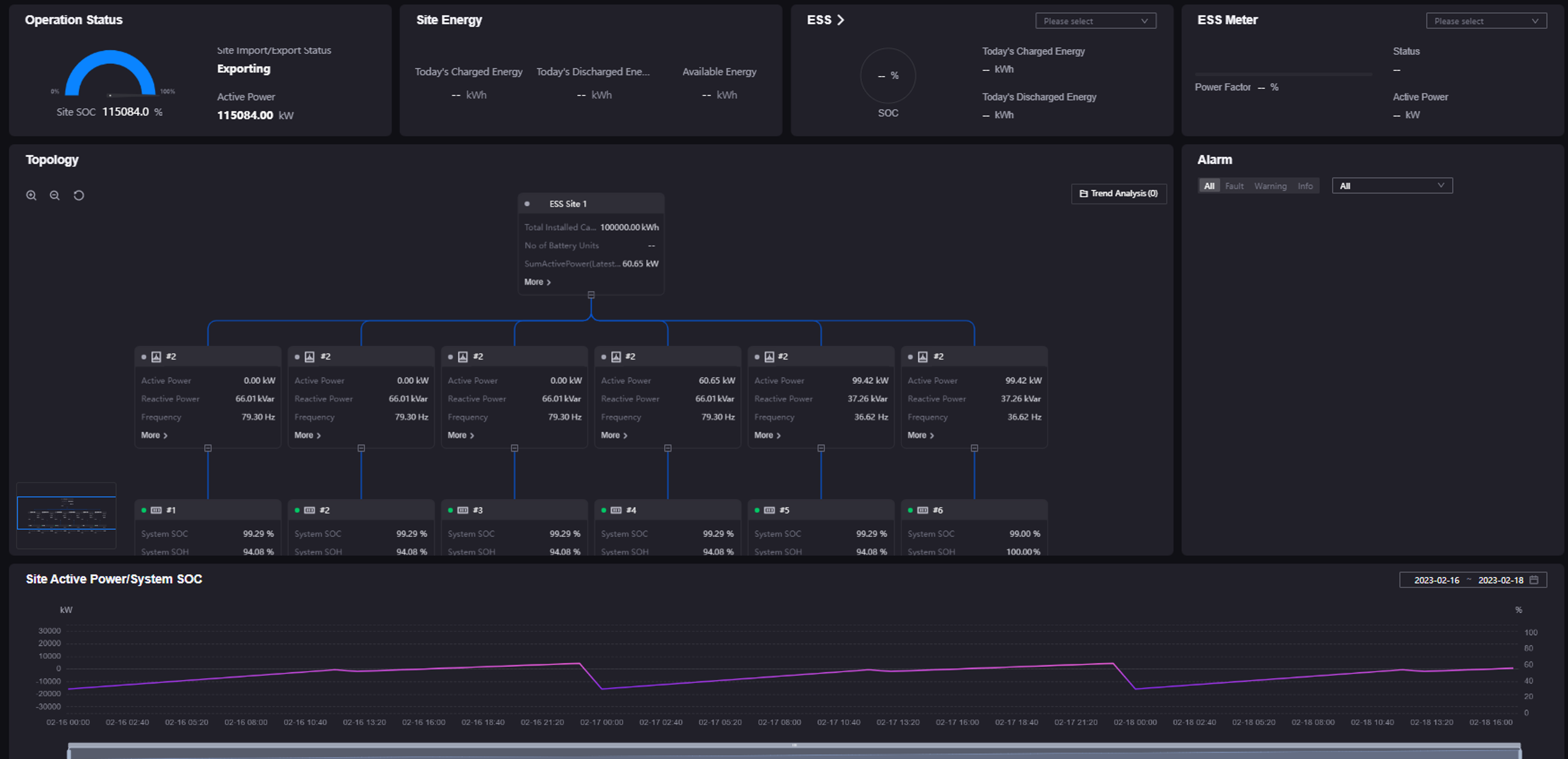
Note
Visible filters, linked-page switchers, and the control button are configured by the application creator. They are also affected by asset permissions and the selected asset, so your page can differ from this example.
Prerequisites
Make sure that your account has Landing Page menu access and the required asset permissions. To control assets, you also need the corresponding control permission. Contact the OU administrator if permissions are missing.
Using the Header Filters
The header can show asset type, grouping, site, device type, device, time interval, time range, site local time, and other controls. A missing control means it is disabled, is incompatible with the current asset dimension, or is unavailable to the current user’s asset permissions.
After you select an asset or time, the Landing Page sends context to the linked page through the SDK. The linked page refreshes with the selection only if it integrates and subscribes to the relevant asset or time context. For DTV-specific filter integration, consult the DTV documentation.
Filtering Data for Specific Assets
Select Landing Page from the left navigation pane.
In the asset-filter header at the top, select the visible asset type, grouping, and site, and, where enabled, the device type and device.
Wait for the linked page to refresh for the new asset scope.
The selectable asset hierarchy and scope, and whether multiple selection is supported, are determined by the page configuration. The multi-asset-tree switcher appears only when all of the following conditions are met:
Multi-asset-tree capability is enabled in the deployment.
The current menu does not disable multi-asset-tree through the URL.
The current account has multiple accessible asset trees.
When tool pages such as Asset Overview are embedded in a Landing Page, the embedded tools usually hide their own duplicate asset-tree entries and use the asset context provided by the container.
Filtering Data for a Time Period
If the header shows the time-interval filter, select Day, Month, or Year.
If it shows the time-range filter, select a time point or a time range.
If quick switching or time shortcuts are available, use them to move to an adjacent period or apply a preset range.
The linked page receives the new start time, end time, and interval. Time format, earliest and latest limits, time-point versus range selection, and shortcuts are configured for the page.
Switching Linked Pages
When a page is linked by asset attribute and the current asset context produces multiple usable page mappings, the header shows tabs or buttons.
Select the target tab or button.
The main area of the page loads the corresponding linked page.
No switcher is shown when the page uses a single-page URL or when the current context has only one usable mapping.
Controlling Devices
The header displays Control only when the application creator enabled control settings, the current selection is a controllable single site or single device, and you have control permission.
Select Control in the header to open the control panel.
Perform the control operations under the rules configured in the control panel.
For more information, see Exploring the Control Panel. If Control is not displayed, contact the administrator to check the control configuration, the current asset selection, and permissions.
DTV Editing and Template Entries
When the linked page is a DTV page, the corresponding entry is enabled in the configuration, and the user has DTV permission, a DTV editing or template-management entry may appear at the top. Personal editing, OU-level management, and widget-content editing require different permissions; these operations belong to the embedded DTV page and do not modify the Landing Page container itself.
Common Display Issues
The linked page does not refresh: Verify that it integrates the Landing Page SDK and subscribes to the current asset or time context.
The page is blank or reports an invalid URL: Verify the linked URL and that its domain is in the iframe-domain allowlist.
The multi-asset-tree entry is missing: Check deployment multi-tree capability, menu URL parameters, and the number of asset trees available to your account.
Filters or the control button are missing: Check page feature switches, asset dimension, asset permissions, and the selected asset.
Function Configurations are missing: The entry is shown only to users with the
monitor_ou_templatepermission.
For menu URL and state parameters, see URL Parameters.