Configuring Portfolio
This page explains how application developers configure Portfolio pages.
Prerequisites
The current account has menu access to the Portfolio page in the target application, as well as the relevant permission points for editing the Portfolio page. If these are not assigned, contact your OU administrator.
The attributes, measurement points, and metrics of the relevant assets have been registered in EnOS. If needed, you can query the registered data through the EnOS Common Data Service APIs.
You have read Exploring Portfolio to learn about the functions of the Portfolio page.
Note
Unified Monitoring supports custom menu names, so the actual menu name may differ from this page. The following sections use the default name “Portfolio” to refer to the Portfolio menu configured in the application.
Entering the Portfolio Configuration Page
After the application creator’s account has the permission points for editing Portfolio, follow these steps to enter the Portfolio configuration page:
In the left navigation bar of the target application, select the Portfolio page.
In the shortcut toolbar on the right side of the page, select the Function Configurations
 button to open the Portfolio configuration page.
The Portfolio configuration page is a five-step wizard, in the following order:
Basic Settings: specify the asset dimension, asset types, and data refresh interval.
Layout Settings: specify the positions of canvases and filters on the page.
Map Settings: specify the map type, map source, coordinate system, and map display effects.
Asset Settings: specify the display style, status, and filtering of assets on the map.
Canvas Settings: configure canvases and widgets for each asset level and asset type.
Note
When switching asset dimension or page layout, the system prompts that some canvas- and panel-related configurations will be replaced or lost. Therefore, it is recommended to determine these two items at the beginning of the configuration, before configuring the map, assets, and canvases.
Basic Settings
In the Basic Settings step, you can configure the asset dimension, asset types, data refresh interval, and some UI text of the Portfolio page.
Configuring the Asset Dimension
The Asset Dimension is the range of asset levels that end users can view on the Portfolio page, and the asset map displays data according to the dimension specified by the end user. You can configure the following asset dimensions for the map:
Asset Dimension |
Description and Use |
Conditions and Limitations |
|---|---|---|
Global |
The broadest asset perspective, providing globally aggregated information. In the asset tree in the upper-left corner of the map, end users can single-select a global, region, or site node to view asset maps at different levels. Suitable for group-level monitoring Portfolios. |
Supports canvases and map configuration at the global, region, and site levels. Only this dimension supports administrative maps and associated resource data. |
Multiple Sites |
The asset perspective of a custom selection of multiple sites. In the asset tree in the upper-left corner of the map, end users can multi-select sites to view the asset map of multiple sites. Suitable for regional company or district management scenarios. |
The region level cannot be configured; canvases only have the global level and the site level. |
Single Site |
The finest asset perspective, focusing on a single site. In the asset tree in the upper-left corner of the map, end users can only select a single site to view the asset map of that site. Suitable for site centralized control rooms. |
Only 1 asset type can be selected; administrative maps are not supported; only this dimension supports 3D maps. |
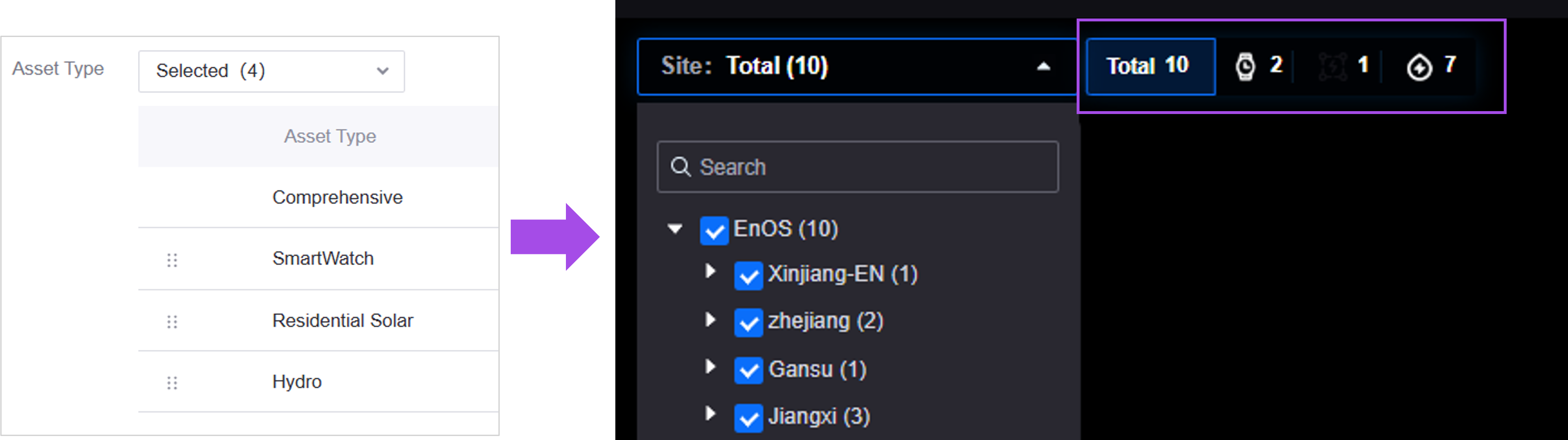
The following figure shows the different selection modes of the asset tree in the upper-left corner of the page under the Global, Multiple Sites, and Single Site dimensions:

Configuring the Asset Type
An asset type classifies assets by business domain or energy technology type, such as wind and solar. After configuration, end users can only view asset data of the specified domains. For example, when you only select the “Wind” type:
The map only displays data of wind farms that end users have permission to view.
Under the “Global” and “Region” nodes of the asset tree, only the data of wind farms within the user’s permission is aggregated.
No end user can view sites of other types on the current page.
The asset types and their names are determined by the business object types in EnOS Common Data Service. To define other asset types, contact your system administrator.
You need to select at least one asset type. Configure it as follows:
In the Asset Type drop-down list, select one or more types. After selection, the asset tree in the upper-left corner of the map will only display assets of the specified types.
When the Asset Dimension is
GlobalorMultiple Sites, multiple asset types can be selected. When 2 or more types are selected, the Comprehensive type is selected by default.When the Asset Dimension is
Single Site, only 1 asset type can be selected.
When multiple asset types are selected, you can sort the asset types by dragging them in the asset type list below.
Tiled buttons of the asset types will be displayed in the upper-left corner of the map for filtering asset types.
The top-to-bottom order of asset types is the left-to-right order of options in the asset filter. The Comprehensive type provides a cross-domain aggregated view, corresponds to the All option, is placed at the top/leftmost by default, and can be configured separately with its own map, assets, and canvases. When the Comprehensive type is checked, at most 2 other asset types can be selected.
Configuring the Refresh Interval
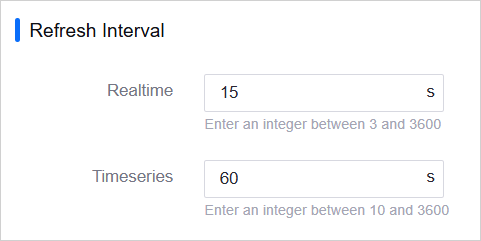
The Refresh Interval is the time period at which the system automatically retrieves and updates page data from the server. You can set the refresh interval, in seconds, for the following two types of data:
Realtime: data that changes rapidly and needs to be monitored in real time, such as instantaneous power and real-time wind speed. It is recommended to set a short refresh interval, such as 5, 10, or 30 seconds, to detect faults in time. The value ranges from 3 to 3,600 seconds, with a default of 15 seconds.
Timeseries: cumulative or statistical data used for trend analysis that changes relatively slowly, such as cumulative energy generation and average power. Such data does not require second-level updates; a longer refresh interval, such as 60 or 300 seconds, can be set to avoid unnecessary resource consumption. The value ranges from 10 to 3,600 seconds, with a default of 60 seconds.
Note
Setting the refresh interval too short will significantly increase the amount of data requests and affect page performance. For Portfolio scenarios with many widgets on a page, it is recommended that the refresh interval of real-time data be no less than 10 seconds.
Customizing UI Text
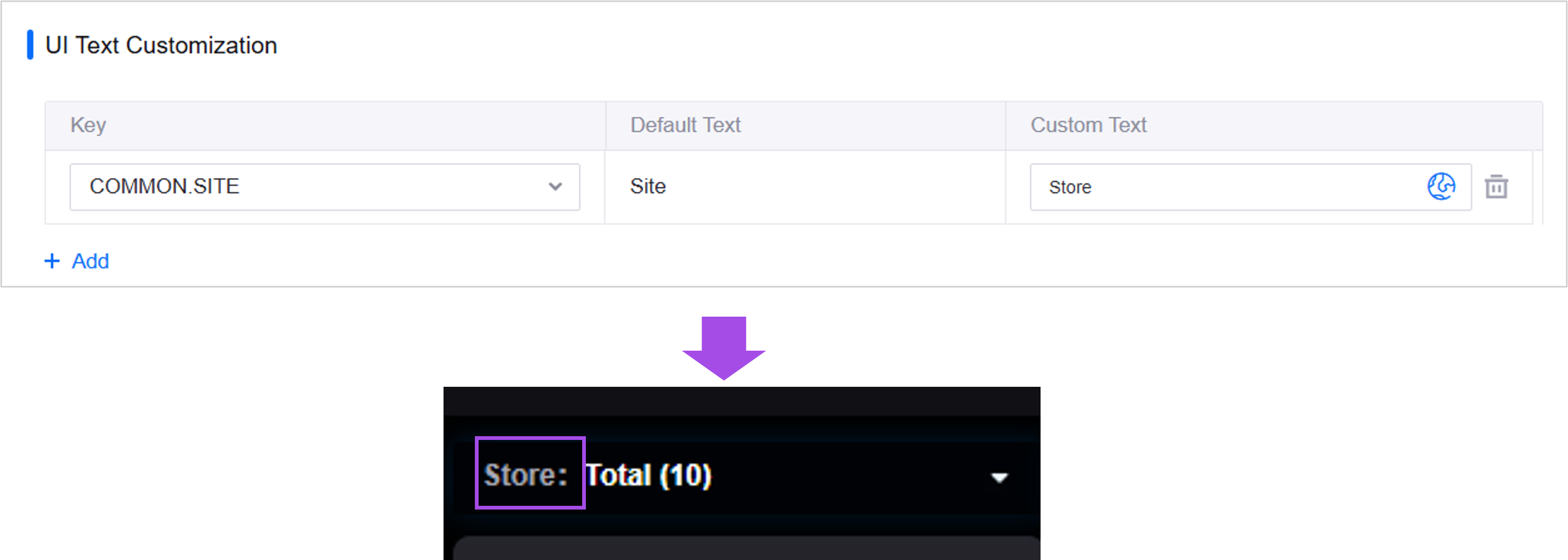
To meet project-specific requirements such as terminology presentation and brand exposure, you can uniformly update certain specific terms in the Portfolio interface, including both the configuration page and the end-user page. For example, the standard term “site” can be replaced in batch with the business term “store”.
To customize the interface text, follow these steps:
Find UI Text Customization in the Basic Settings step page.
Select + Add, and select or enter a key name in the Key column. Each key name can only be configured once. To customize more text, contact your system administrator for the key names.
In the Default Text column, view the text to be replaced.
In the Custom Text column, enter the updated text. Internationalized input is supported.
After configuration, the Default Text value in the system text will be uniformly replaced with the Custom Text value. Text you enter yourself in later steps (such as widget titles and data field names) is not affected.
Layout Settings
In the Layout Settings step, you can specify the positions of canvases and filters on the Portfolio page, as well as the display of the title bar and full-screen related settings.
Configuring the Page Layout
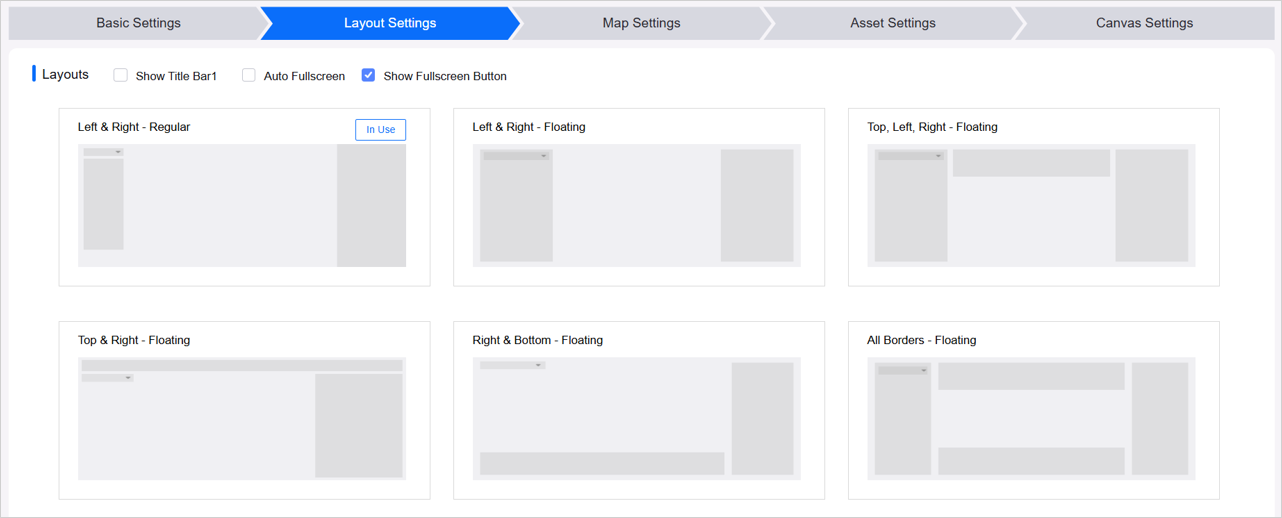
The page layout determines the positions of canvases and filters on the Portfolio page. Portfolio provides multiple page layouts to meet diverse visual monitoring page requirements. To configure the layout of the Portfolio page:
In the Portfolio configuration page, select to enter the Layout Settings step.
Hover the cursor over the target layout and select Apply to change the page layout. Portfolio supports the following page layouts.
Page Layout
Description
Use
Left & Right - Regular
A narrow canvas on the left, a wide canvas on the right, and the filter above the left canvas.
A regular monitoring page with the map as the main body, supplemented by a few metric cards.
Left & Right - Floating
Canvases of equal width on the left and right, with the filter above the left canvas.
A balanced layout where both sides need to carry many widgets.
Top, Left, Right - Floating
Canvases of equal width on the left and right, a narrow canvas at the top, and the filter above the left canvas.
A Portfolio that needs to display global key metrics at the top.
Top & Right - Floating
A wide canvas on the right, a narrow canvas at the top, and the filter below the top canvas.
A page where the map takes up a large area and rankings are displayed on the right.
Right & Bottom - Floating
A wide canvas on the right, a narrow canvas at the bottom, and the filter in the upper-left corner of the page.
A page that emphasizes map display, with widgets as auxiliary information.
All Borders - Floating
Canvases of equal width on the left and right, narrow canvases at the top and bottom, and the filter above the left canvas.
A command center Portfolio with the largest number of widgets.
The layout currently in use is marked as In Use.
Note
Switching the page layout will cause some panel-related configurations to be lost. It is recommended to determine the page layout before configuring canvases and widgets.
Configuring the Title Bar
Show Title Bar is disabled by default. When enabled, a title bar is added at the top of the page, displaying the page title on the left and a clock that refreshes in real time with the system time on the right. At the same time, a Show Title Bar switch will appear in the map settings panel at run time, and end users can choose whether to display the title bar themselves (displayed by default). When this configuration item is disabled, no title bar is displayed at the top of the page, the canvas area extends to the top of the page, and the corresponding switch does not appear in the run-time map settings panel.
The title bar is suitable for scenarios where the purpose of the page or the owning organization needs to be clearly identified on the Portfolio, such as “XX Group New Energy Monitoring Center”.
The title name supports internationalized input, with a maximum length of 50 characters.
Configuring Full-Screen Display
Auto Fullscreen is disabled by default. When enabled, when end users access the Portfolio page URL, the page automatically switches to full-screen mode, and the top toolbar and left menu bar of the EnOS Application Portal are automatically collapsed. This is suitable for pages fixed on a Portfolio for long-term display. When disabled, the page opens in normal view mode and does not automatically enter full screen.
Show Fullscreen Button is enabled by default. When enabled, a Full Screen button is added to the shortcut toolbar of the page, and end users can click it to manually enter or exit full screen at any time. When disabled, the button is no longer displayed in the shortcut toolbar; if Auto Fullscreen is also disabled, end users will have no entry to full screen on the page (they can still enter full screen using the browser’s built-in full-screen function). If the page is embedded in another page, you can disable this item to avoid invalid action entries.
Map Settings
The asset map in Portfolio supports multiple map types and map sources, and provides rich configuration items for displaying the asset distribution and data within a specific geographical range. Through the following configurations, you can customize the asset map displayed on the Portfolio page.
Showing Map
This function controls whether the map is displayed on the Portfolio page.
In the upper-left corner of the Map Settings step page, find the Show Map option.
This function is enabled by default. When enabled, the map is displayed on the Portfolio page and you can customize the map configuration.
If this function is disabled, the map cannot be displayed on the Portfolio page, and all related map settings are unavailable. After the map is disabled, the page consists only of canvases and widgets, which is suitable for pure metric dashboard pages.
Enabling Map Settings
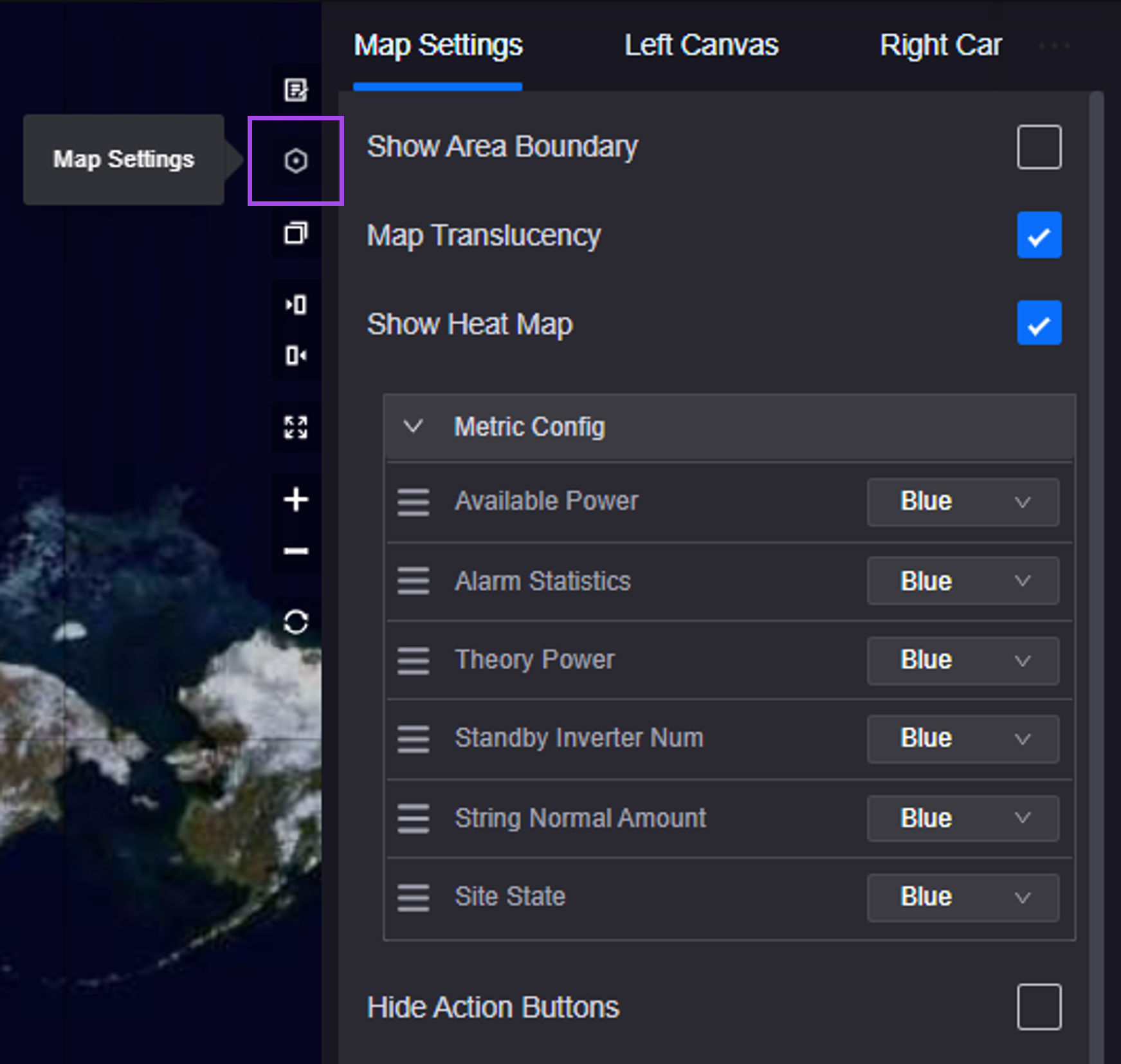
This function controls whether end users can customize the map on the Portfolio page, including the map display effects and showing/hiding legends and canvases.
In the upper-left corner of the Map Settings step page, find the Enable Map Settings option.
This function is enabled by default. When enabled, end users can click the Map Settings
button in the shortcut toolbar in the upper-right corner of the Portfolio page (as shown in the following figure) to customize map settings.If this function is disabled, end users cannot use the map settings function and can only view the map view preset by the application creator. For example, when the page is used as a Portfolio for reporting with a unified standard and you do not want end users to change the display effects, you can disable this item.
Enabling Mask
This function overlays a translucent mask on top of the map, with the mask effect being bright in the center and dark around the edges. When asset information on the map is dense and canvas widgets are hard to distinguish, enabling the mask can improve the readability of the widgets. End users can also enable or disable it themselves through Map Translucency in the run-time map settings.
This function is disabled by default. To configure it, check the Enable Mask option in the upper-left corner of the Map Settings step page.
When enabled, the mask is displayed on the map.
Configuring the Map Type
The map type determines the visual style and base layer of the asset map. Different asset dimensions support different map types.
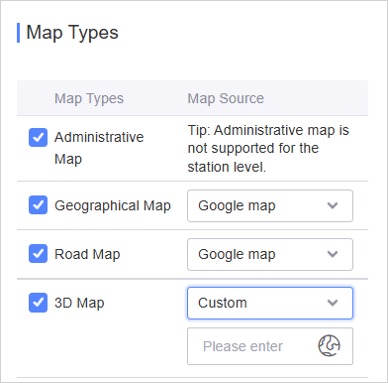
On the right side of the Map Settings step page, find the Map Types list and check the map types available on the page. The selected types will affect the options that can be configured later.
At least one map type must be checked. The available types include:
Map Type
Description and Use
Conditions and Limitations
Administrative Map
Displays administrative regions as the main body, allowing coloring by province or city and displaying heat maps and regional aggregation. Suitable for group-level regional performance comparison.
Only applicable to the Global and Multiple Sites dimensions. This type is not displayed when the Asset Dimension is
Single Site; drilling down to the site level is not supported; custom map sources are not supported.Geographical Map
Provides satellite imagery as the base map, intuitively showing the terrain and landforms around sites. Suitable for site location review and on-site situation display.
Applicable to the Global, Multiple Sites, and Single Site dimensions.
Road Map
Provides vector information such as road networks, with a clean map. Suitable for O&M dispatching scenarios that focus on traffic accessibility.
Applicable to the Global, Multiple Sites, and Single Site dimensions.
ECDIS
Designed for maritime applications, displaying water depth, channels, and other information. Suitable for offshore wind power scenarios.
Requires that an ECDIS source has been configured in the deployment environment; otherwise this option is not displayed.
3D Map
Provides 3D terrain effects and can display models of devices such as wind turbines. Suitable for immersive display of a single site.
Only applicable to the Single Site dimension, and requires that a 3D map source has been configured in the deployment environment. The Elevation Layer URL can be additionally configured.
Select a map source from the Map Source drop-down list for the corresponding map type. The available sources are supplied by the deployment environment. A source appears only when it is enabled, and provides a URL for the selected map type. The Administrative Map has no map-source selector.
Map Source
Description and Use
Conditions and Limitations
Deployment-provided source
A map service configured for the current deployment, such as Tiandi Map, Google Map, Offline Map, Mapbox, or Dark Mapbox.
The exact source names and availability vary by deployment, OU, language, enabled state, and map type. Mapbox and Dark Mapbox are examples only; they appear only when the current environment configures them.
Legacy fallback sources
When the configuration is absent or empty, the editor falls back to Tiandi Map, Google Map, and Offline Map.
This fallback is not the authoritative list for deployments.
Custom
Uses a tile service address you provide yourself. Suitable for scenarios that need to integrate third-party or industry-specific base maps.
Available only for Geographical Map, Road Map, and 3D Map. Supports internationalized configuration, allowing different map addresses for different display languages.
After selecting Custom, enter the address. This field supports internationalized input, allowing different addresses to be configured for different display languages, so that different base maps are displayed under different languages.
Configuring the Coordinate System
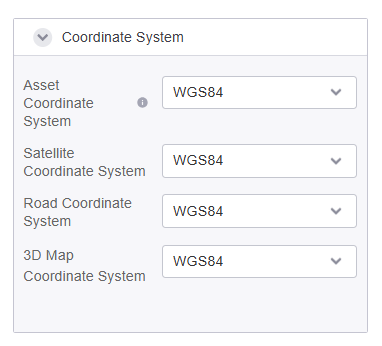
The coordinate system defines the reference system for geographical locations on the map. A correct coordinate system configuration is the prerequisite for accurately displaying asset locations. Ensure that the asset coordinate system is consistent with the coordinate system of the selected map base map; otherwise, asset locations will be displayed with deviations.
To configure the coordinate system, follow these steps:
On the right side of the Map Settings step page, find the Coordinate System configuration item.
Configure the corresponding coordinate system according to the source of your asset data and the map type used:
Asset Coordinate System: determines the coordinate system standard used by the asset longitude and latitude attribute values. The following three coordinate systems are supported:
WGS84: the international standard, which is usually used by the raw data of GPS devices. When asset coordinates come from international GPS devices or Google Maps, it is recommended to select WGS84.GCJ02: the coordinate system formulated by the National Bureau of Surveying and Mapping of China, which encrypts and offsets WGS84 coordinates.BD09: the coordinate system used by Baidu Maps, which is further encrypted on the basis of GCJ02. When asset coordinates come from Baidu Maps, it is recommended to select BD09.
Satellite Coordinate System: the coordinate system used by the Geographical Map. It supports
WGS84andGCJ02and is shown only when the Geographical Map is enabled and its selected deployment-provided source does not define a coordinate system. Otherwise, the source configuration determines the coordinate system.Road Coordinate System: the coordinate system used by the Road Map. It supports
WGS84andGCJ02and is shown only when the Road Map is enabled and its selected deployment-provided source does not define a coordinate system. Otherwise, the source configuration determines the coordinate system.3D Map Coordinate System: the coordinate system used by the 3D Map. It supports
WGS84andGCJ02and is shown only when the 3D Map is enabled and its selected deployment-provided source does not define a coordinate system. Otherwise, the source configuration determines the coordinate system.
Configuring Custom Administrative Boundaries
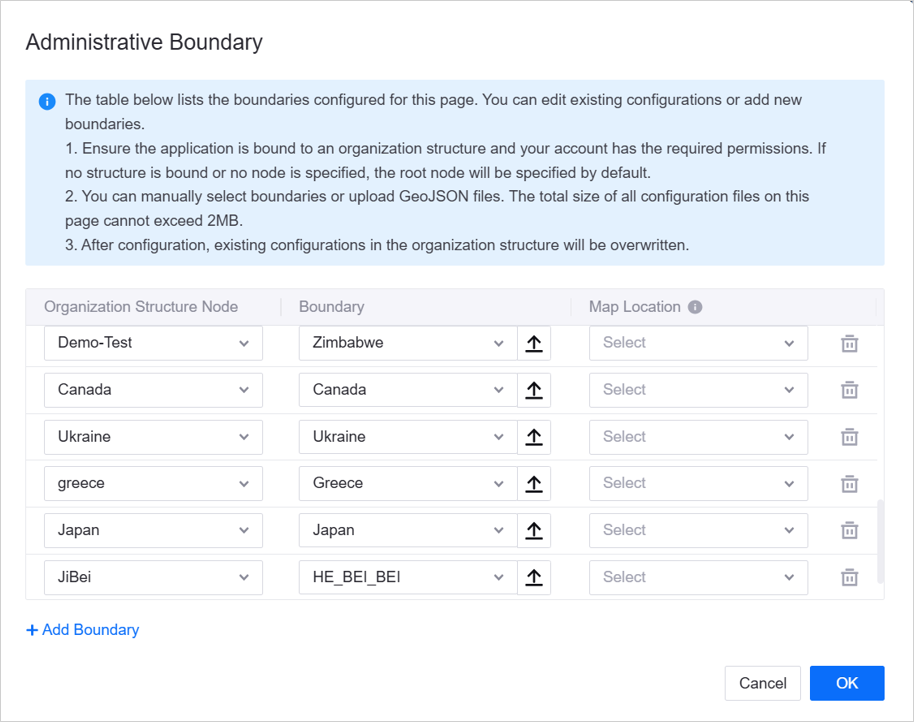
The built-in administrative boundaries of the system usually go down to the province or city level. If the project needs to display district or county level boundaries, or needs to divide boundaries by custom management districts, you can configure administrative boundaries separately for nodes in the organization structure.
Before configuration, ensure that the current application has been bound to an organization structure and that the current account has permission to that organization structure.
In the Map Settings step page, find the Administrative Boundary configuration item. The table lists the boundary lines already configured for the current page, where the Default View row corresponds to the root node of the organization structure, the boundary line is World by default, and it cannot be deleted. To edit an existing configuration or add a boundary line, follow these steps:
Select + Add Boundary to add a new row to the table.
In the drop-down list of the Organization Structure Node column, select the node for which the boundary needs to be configured. If a row does not specify a node, it corresponds to the root node by default.
Specify the boundary range in the Boundary column:
Select a built-in administrative region from the drop-down list; or
Select the upload icon on the right of the drop-down list and upload a GeoJSON file to customize the boundary range. The total size of all configuration files on the current page must not exceed 2 MB.
In the Map Location column, select the display position of the node on the map of its parent node, which is used to determine the aggregation point and label position of the node. The Default View row corresponding to the root node does not need a map location.
To remove the configuration of a row, select the delete icon on the right of that row. The row corresponding to the root node cannot be deleted.
Configuring the Global Map
The Global configuration panel appears on the right side of the Map Settings step page only when the Asset Dimension is Global or Multiple Sites, and is used to configure the map of the global level (and the region level, see Configuring the Region Map) in detail. This configuration panel does not appear when the Asset Dimension is Single Site.
First configure the items common to this level:
Configuration Item |
Description |
Conditions and Limitations |
|---|---|---|
Map Types |
Select the types available for the global level from the checked map types. |
The candidate range comes from the checked results in Configuring the Map Type. |
Default Map Type |
Specifies the map type displayed by default when the Portfolio page is first loaded. |
Appears only when 2 or more map types are available at this level. |
If the Administrative Map is enabled, the following items can be configured:
Configuration Item |
Description and Use |
Conditions and Limitations |
|---|---|---|
Show Mini Map |
Displays the global administrative map as a thumbnail in the corner of the map, helping end users understand the position of the current view in the global context. Enabled by default. When disabled, the mini map is no longer displayed on the map, and the switch no longer appears in the run-time map settings panel. |
When enabled, the Mini Map View can be further specified. |
Background |
Sets the background color of the administrative map or a custom background image. |
When Custom is selected, the Picture URL needs to be entered, with a maximum length of 500 characters. |
Enlarge Font |
Enlarges the font size of administrative region name labels in the administrative map, and also enlarges the font size of data names and values in canvas widgets. Disabled by default, using the system default font size. |
Suitable for viewing a Portfolio from a distance on a large screen. |
Looping Display by Regions |
Disabled by default. When enabled, the map automatically loops through the data of each administrative region in the form of floating cards, suitable for unattended Portfolio looping display. When disabled, the map does not automatically loop through region data, but the region aggregation icons are still displayed normally, and end users can still manually click to view the data of each region. |
When enabled, the looping rules, looping order, and time interval need to be configured. |
Sorting Rule |
Specifies the data on which region looping is based, supporting |
Looping Display by Regions must be enabled first. Selecting |
Display Order |
Specifies the looping display order, supporting |
Looping Display by Regions must be enabled first. |
Looping Interval |
Specifies the display time of each floating card, in seconds. |
The value ranges from 1 to 60 seconds, with a default of 10 seconds. Looping Display by Regions must be enabled first. |
Enable Asset Aggregation |
Disabled by default. When enabled, end users are allowed to display assets concentrated by region as aggregation icons at run time. When disabled, no aggregation icons appear on the map, and all sites/regions are always displayed one by one with their own independent icons. |
The administrative map only supports aggregation |
Aggregation Icon Size |
Adjusts the display size of aggregation icons. |
The value ranges from 0.5 to 2, with a step of 0.1 and a default of 1. Appears only after Enable Asset Aggregation is enabled. |
If the Geographical Map, Road Map, or ECDIS is enabled, the following items can be configured:
Configuration Item |
Description and Use |
Conditions and Limitations |
|---|---|---|
Max Zoom in Level |
Specifies the range of zoom levels supported by the map. The larger the zoomable levels, the larger the maximum scale the map supports. |
The value ranges from 0 to 22. |
Zoom Granularity |
Specifies the zoom ratio of the map for each unit adjusted in the zoom level. The smaller the zoom granularity, the more precisely the map can be zoomed in or out. |
The default is 1, which can be selected between 0 and 1, with a precision of 0.1. |
Auto-Center Default View |
The system automatically calculates the map center point and default zoom level based on the asset distribution. |
Enabled by default. When disabled, the longitude and latitude of the Center Point and the Default Zoom need to be entered manually. The longitude ranges from -180 to 180, the latitude ranges from -90 to 90, and the default zoom level ranges from 0 to 22. |
Enable Asset Aggregation |
Disabled by default. When enabled, end users are allowed to aggregate nearby assets into one icon at run time, suitable for scenarios with a large number of assets and overlapping icons. When disabled, no aggregation icons appear on the map, and all assets are always displayed one by one with their own independent icons. |
The aggregation methods selectable by end users can be configured, supporting |
Aggregation Zoom Level |
Specifies the zoom level at which asset aggregation is triggered. For example, if set to 3, assets start to aggregate when the map zoom level is greater than or equal to 3. |
The value ranges from 0 to 22, with a default of 15. Appears only after Enable Asset Aggregation is enabled. |
Looping Display by Provinces |
Disabled by default. When enabled, the map automatically loops through the data of each provincial administrative region in the form of floating cards; when disabled, the data is not looped automatically, but icons aggregated by province are still displayed normally, and end users can manually click to view them. |
Enable Asset Aggregation must be enabled first and the aggregation method must include by province; otherwise this configuration item does not appear. |
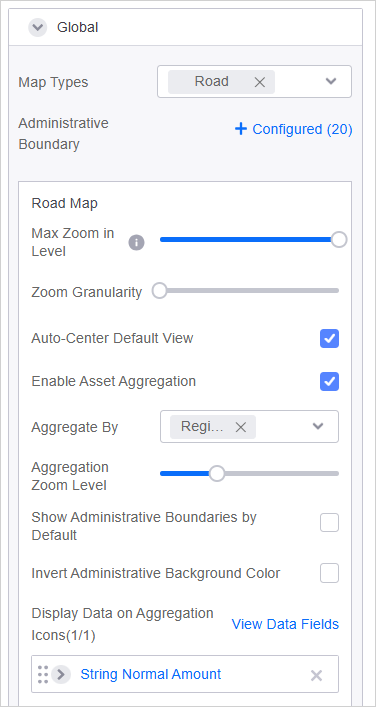
Show Administrative Boundaries by Default |
Determines whether administrative boundaries are overlaid and displayed by default when the map is first loaded. Disabled by default, that is, administrative boundaries are not displayed when the map is first loaded. |
This configuration item only determines the initial state. Whether enabled or disabled, end users can always manually toggle administrative boundaries in the run-time map settings later, and the user’s manually switched choice will be remembered and no longer change with this configuration item. |
Invert Administrative Background Color |
Determines the filling method of administrative boundaries, disabled by default. When disabled, each administrative region itself is filled with a translucent color block according to the boundary, and no color is overlaid on the blank map area outside the region. When enabled, the effect is reversed — the administrative regions themselves are no longer filled (only the boundary strokes are retained), and a translucent color block is overlaid on the entire map outside the regions, with only the administrative region ranges themselves hollowed out. |
Suitable for maps that need to emphasize areas outside the jurisdiction in reverse. |
Display Data on Aggregation Icons |
Specifies the data fields displayed in aggregation icons, and configures their names, units, formats, and aggregation methods. |
At most 1 data field can be configured. |
Donut Chart |
Displays aggregation points as donut charts, used to show metric progress as percentages. |
The data field corresponding to the donut chart needs to be specified, and its name and color configured. |
Aggregation Attribute |
Specifies the asset attribute on which aggregation |
Needs to be configured only when the aggregation method includes by attribute. |
Associated Record |
Configures the associated record information for aggregation points. |
— |
Popup Display Settings |
Configures the content displayed in the pop-up when end users click an aggregation point, supporting the Data Field and Embedded Content types. |
When |
Data in Aggregation Popups |
Specifies the data fields displayed in the floating card of an aggregation point. |
— |
Heat Map |
Displays the metric data of each region in the form of color blocks. The heat map range, heat map data source ( |
When |
Note
The above configuration items only determine which capabilities end users can use at run time. The final effect seen by end users also depends on their selections in the map settings panel. See Editing the Portfolio Page.
Configuring the Region Map
Only when the Asset Dimension is Global does a separate Region configuration panel appear on the right side of the map configuration wizard, in which case end users can drill down from the global map to the region map. When the Asset Dimension is Multiple Sites or Single Site, there is no region level and this configuration panel does not appear. The region level map directly follows the configuration logic of the Global configuration panel and has no configuration items that can be set separately.
If you need the region level to display different canvas content from the global level, you can configure canvases and widgets separately for the region level in the subsequent Canvas Settings step.
Configuring the Site Map
In the Organization configuration panel on the right side of the Map Settings step page, you can configure the site level map. Since all Asset Dimensions (Global, Multiple Sites, Single Site) include the site level, this configuration panel always appears.
Note
“Organization” is the default name of this configuration panel. If the default text of the corresponding key name has been replaced in Customizing UI Text (for example, replaced with “Store”), the replaced name will be displayed here.
Configuration Item |
Description and Use |
Conditions and Limitations |
|---|---|---|
Map Types |
Select the types available for the site level from the checked map types. |
Does not include the Administrative Map. |
Default Map Type |
Specifies the map type displayed by default on the site map. |
Appears only when 2 or more map types are available at this level. |
Max Zoom in Level / Zoom Granularity |
Specifies the range of zoom levels and the zoom precision supported by the site map. |
Appears only when the Asset Dimension is |
Enable Asset Aggregation |
Disabled by default. When enabled, end users are allowed to aggregate devices into one icon on the site map, suitable for sites with a large number of wind turbines and dense icons. When disabled, no aggregation icons appear on the site map, and all devices are always displayed one by one with their own independent icons. |
The aggregation methods selectable by end users can be configured, supporting |
Auto-Center Default View |
The system automatically calculates the center point and zoom level of the site map based on the device distribution. |
Enabled by default. It can be configured separately for each asset type. When disabled, the Default Zoom needs to be specified, ranging from 0 to 22, with a default of 22. |
Asset Settings
In the Asset Settings step, you can configure the display style, status, filtering, and pop-up content of assets on the map, as well as the behaviors related to the asset filter and associated resources.
Enabling the Asset Filter
This configuration item is not limited by the Asset Dimension and appears under the Global, Multiple Sites, and Single Site dimensions.
Enabled by default. When enabled, the asset tree filter is displayed in the upper-left corner of the map, and end users can switch the asset level and asset scope to view through the asset tree, suitable for scenarios where end users need to drill down on their own to view different regions or sites.
When disabled, the asset tree filter is no longer displayed in the upper-left corner of the map, and the back icon is displayed in the shortcut toolbar instead.
Filter nodes without permission is read-only and cannot be edited. Its displayed value is Disabled.
Configuring Associated Resources
The Configure Associated Resources area appears in the Asset Settings step page only when the Asset Dimension is Global. This configuration item does not appear when the Asset Dimension is Multiple Sites or Single Site.
The group and region nodes in the organization structure can be associated with resource instances. After associated resources are enabled, Portfolio can display the data and locations of the resources associated with these nodes, instead of only the aggregated data of the sites under them.
Configuration Item |
Description and Use |
Conditions and Limitations |
|---|---|---|
Show Data of Associated Resources |
Disabled by default. When enabled, when end users select a group or region node, Portfolio will display the data of the resources associated with that node. Suitable for scenarios where the region node itself also carries physical assets (such as a regional centralized control station). When disabled, even if the node has been associated with resource instances in the organization structure, the page still only displays the aggregated data of all sites under the node, and does not use the data of the associated resources. |
It can be configured only when the Asset Dimension is |
Permission Check |
When enabled, the system checks the end user’s asset permission on the associated resources, and resource data without permission will not be displayed. When disabled, this check is not performed. To manage user permissions, contact your OU administrator. |
Show Data of Associated Resources must be enabled first. |
Show Icon of Associated Resources |
Disabled by default. When enabled, associated resources will display location icons on the map according to their longitude and latitude attributes; when disabled, associated resources do not display independent location icons on the map. |
The associated resources need to have longitude and latitude attributes configured; otherwise they cannot be located on the map. That is, the model inherited by the resource instance needs to have two standard attributes with identifiers exactly |
Configuring Global-Level Assets
The Global configuration panel appears on the right side of the Asset Settings step page only when the Asset Dimension is Global or Multiple Sites. This panel does not appear when the Asset Dimension is Single Site, and the display of devices inside the site is instead configured in Configuring Site-Level Assets. This panel is also used to configure how assets are displayed on both the global and region maps; the region level does not provide separate configuration items.
First configure the general items applicable to all asset types:
Configuration Item |
Description and Use |
Conditions and Limitations |
|---|---|---|
Asset Category |
Displays the asset category of the current level, which is site (organization) for the global level. |
Read-only and cannot be modified. |
Site Style |
The display style of sites on the map, supporting |
The default is |
Icon Size |
Adjusts the display size of site icons. |
The value ranges from 0.5 to 4, with a step of 0.1 and a default of 2. It can be configured only when the site style is |
Show Asset Name |
Displays the site name below the site icon. Suitable for maps with few sites where sites need to be identified directly. |
It can be configured only when the site style is |
Show Asset Data |
Disabled by default. When enabled, value bubbles of ranking or heat map data fields are overlaid at the bottom of site icons; when disabled, no value bubbles are displayed under site icons, and only the site name (if enabled) is displayed. |
Ranking or heat map data fields must be configured for the values to actually appear; otherwise, even if enabled, no content appears under the icons. |
Display Data on Aggregation Icons |
Specifies the data fields displayed in aggregation points, and configures their names, units, formats, and aggregation methods. For example, to display the total energy generation of each aggregation point in MWh, select Add Data Field, select the field representing total energy generation in the pop-up window, and set the Name to “Energy Generation” and the Unit to “MWh”. |
It takes effect only after asset aggregation is enabled. |
Donut Chart |
Displays aggregation points as donut charts, used to show metric progress as percentages on aggregation icons. |
The data field corresponding to the donut chart needs to be specified, and its name and color configured. |
Reset Map When Switching Asset Types |
When enabled, when end users switch asset types, the system will recalculate the map center point based on the longitude and latitude of all assets of the current asset type. |
Disabled by default. Suitable for projects where different asset types differ greatly in geographical distribution. |
Then, for each asset type selected in Basic Settings > Asset Type (including Comprehensive), configure the following items separately:
Configuration Item |
Description and Use |
Conditions and Limitations |
|---|---|---|
Show Site Status |
Enabled by default. When enabled, a color block indicating the running status of the site is displayed at the bottom of the site icon. When disabled, site icons use a unified default base style and are no longer distinguished by color. |
— |
Show Site Status Legend |
Displays a legend in the lower-right corner of the map explaining the correspondence between site statuses and colors, which end users can use to filter sites of specific statuses. |
It is shown or hidden together with Show Site Status and cannot be disabled separately. |
Click Site Icon to |
Configures the interaction after end users click a site icon, supporting |
Selecting |
Dimension Filter |
Displays a filter above the map for end users to filter sites by specific dimension types. Select Add Data Field to select data fields in the pop-up window. When no data field is added, the filter does not display any content on the map. |
Up to 10 data fields can be added, and they can be sorted by dragging. A display name can be configured for the filter. Partial selection is supported. |
Legend Filter |
Displays a filter in the lower-right corner of the map for end users to filter sites by specific metric, measurement point, or attribute values. Select Add Data Field to select data fields in the pop-up window and configure the filtering conditions and colors. When no data field is added, the filter does not appear on the map. |
For data fields whose enumeration values contain icons, icon display can be enabled to replace solid color blocks, making the legend meaning more intuitive. |
Click Pop-up Title to |
Configures the link behavior after end users click the title of a site floating card, supporting |
When a link is selected, the Link Address needs to be configured. |
Popup Display Settings |
Configures the content type of the site floating card, supporting |
When |
Data in Details Popup |
Specifies the data fields displayed in the site floating card. Measurement points, metrics, and attributes can be searched by name and identifier, and identifier text can also be copied. |
It needs to be configured only when the Popup Display Settings is |
Show Picture |
Displays the site image in the site floating card. |
When enabled, the image source needs to be configured. |
Layer |
Selects the weather layer types available on the page, such as wind speed, temperature, and irradiance. When no layer is selected, the weather layer entry does not appear in the run-time map toolbar. |
The available layers depend on the weather data sources integrated in the deployment environment. |
Default Weather Layers |
Specifies the layer displayed by default when end users enable weather layers. |
At least one layer must be selected in Layer first; otherwise this configuration item does not appear. End users need the permission point for viewing map layer data to see the weather layer entry at run time. If it is not assigned, contact your OU administrator. |
Configuring Site-Level Assets
In the Organization configuration panel on the right side of the Asset Settings step page, you can configure how various device objects are displayed in the single site map. The system provides configurations separately by asset domain (such as wind, solar, thermal, and hydro).
This configuration panel appears under the Global, Multiple Sites, and Single Site dimensions. However, when the Asset Dimension is Multiple Sites, only the names of each asset domain are displayed, and the per-device detailed configuration items in the following sections of this page (link, layers, trajectories, etc.) are not displayed.
To configure site-level assets, follow these steps:
Show Object Status is enabled by default, displaying icons of the corresponding color for each type of object according to its current running or connection status, and showing status descriptions in the floating card and the legend in the lower-right corner. If you do not need to display status information, you can disable this item. After it is disabled, the icons of this type of object are displayed uniformly in the default blue, and the status row in the floating card and the map legend are hidden at the same time.
Select Add Object Type, and select the object types to be displayed on the site map in the drop-down list. The selectable object types include wind turbines, booster stations, feeders, vehicles, ships, electronic fences, wind resources, irradiance, etc., depending on the current asset domain.
Configure the following items for each object type.
Configuration Item
Description and Use
Conditions and Limitations
Device Status
Selects an enum-type measurement point, metric, or attribute for this object type, as the status data in the map icon color and hover tooltip. When not configured, the system uses the default data field marked as status in the object model.
At most 1 item can be selected. It is displayed only for ordinary objects; wind turbines use the built-in wind turbine status, and this configuration item is not displayed. Whether to display object status as a whole is controlled by Show Object Status above.
Click Pop-up Title to
Configures the link behavior when clicking the pop-up title after clicking the object icon at run time to open the detail pop-up. It supports
Don't Jump,Open in new page, andOpen in same page.When a link is selected, the Link Address needs to be configured, with a maximum length of 500 characters. This configuration item does not control how the detail pop-up is opened.
Show Object Location
Enabled by default. When enabled, the location icons of this object type are displayed in the single site map; when disabled, the object locations of this type are neither requested nor displayed.
The object type needs to have been added to the current asset domain, the object instances need to have valid
longitudeandlatitudeattribute values, and the coordinate system must be consistent with the asset coordinate system selected on the current page. At run time, Show Assets also needs to be enabled and the type selected in the object type legend.Popup Display Settings
Configures whether the detail pop-up displays
Data FieldsorEmbedded Contentafter end users click a map object icon.The default is
Data Fields. AfterEmbedded Contentis selected, the content URL and the width and height of the pop-up need to be configured, and the Data in Details Popup configuration item is no longer displayed.Data in Details Popup
Selects the measurement points, metrics, or attributes displayed in the detail pop-up, and configures aliases and display order. When nothing is selected, the system uses the default fields under the
Portfolio_Cardgroup of the object model.Displayed only when the Popup Display Settings is
Data Fields, with up to 10 items.Click 3D Icon to
Configures the link behavior and URL after clicking a 3D wind turbine model icon.
Displayed only when configured for wind turbine objects in the wind domain, and takes effect only on the 3D map.
Show Object Trajectory
When enabled, a View Track entry is provided in the object detail pop-up, and end users can replay the historical trajectory through the timeline.
Displayed only when configured for vehicles, personnel, or ships in the wind domain; the entry appears in the detail pop-up only when the object has trajectory data and a 2D single site map is used.
The run-time single site map includes two kinds of prompts: hovering the cursor over an object icon shows a brief tooltip, displaying only the object name and status; clicking or tapping an object icon opens the detail pop-up, displaying data fields or embedded content according to the Popup Display Settings. The device detail pop-up is not a separate configuration area in the configuration page, so it does not appear in the configuration UI; the related content is all set in the above object type configuration cards.
If object icons or the detail pop-up do not appear at run time, check the following conditions:
The object type has been added to the current asset domain, and Show Object Location is enabled.
The object instances have valid longitude and latitude attribute values.
Show Asset Location has been enabled in the run-time map settings, and the type has been selected in the object type legend.
A 2D single site map is currently in use. The 3D map only handles wind turbine objects according to the interaction configuration of the 3D model.
Note
Click Pop-up Title only controls the secondary link from the detail pop-up title, and is not used to open the detail pop-up. If the site contains subsystems that need to be viewed on separate pages, such as energy storage stations, you can set the link URL through this configuration item.
Canvas Settings
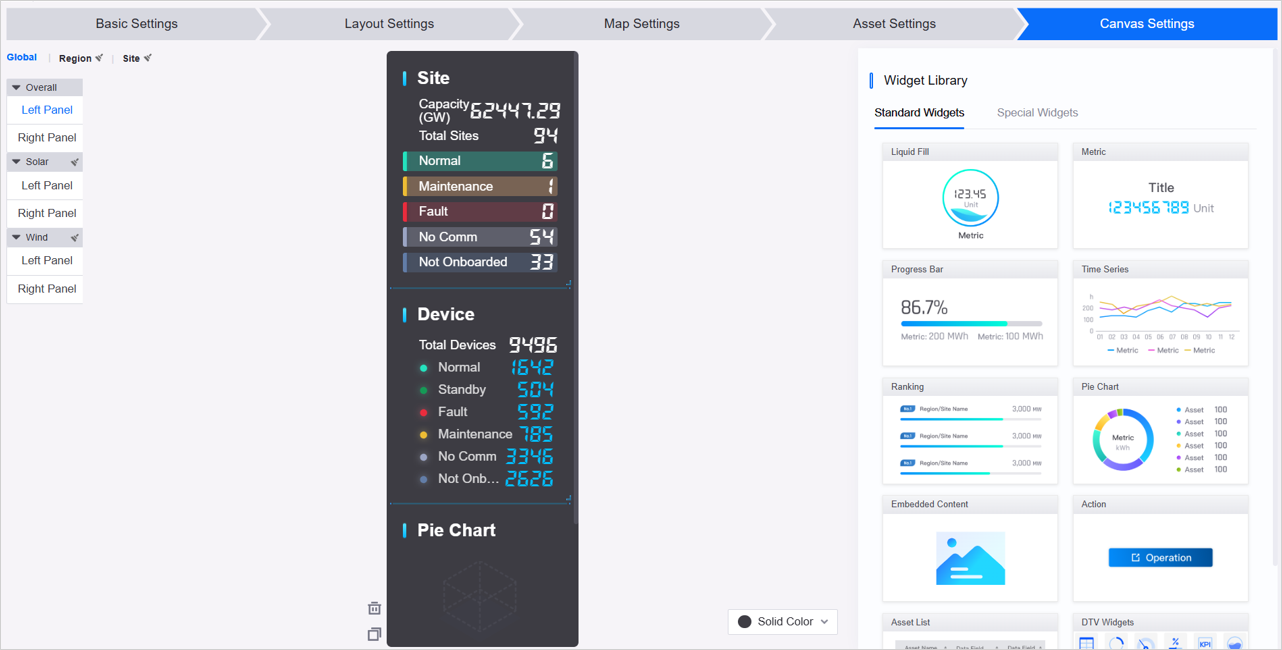
Portfolio canvases support statistics and analysis of asset data through rich visualization widgets, and canvases and widgets can be configured separately for each asset level and asset type, enabling custom and visual configuration of monitoring pages.
Configuring Canvases
A canvas is the area that carries widgets, located around the map. Portfolio organizes canvas configurations in three layers: “asset level → asset type → panel”.
To configure canvases, follow these steps:
In the Portfolio configuration page, select to enter the Canvas Settings step.
In the left side of the page, select the asset level tab (
Global,Region, orSite), then expand the asset type group and select the panel to configure. Panels includeTop,Bottom,Left, andRight, and the available panels depend on the page layout selected in Layout Settings. Empty canvases without any widgets are marked with a red asterisk, making it easy to quickly locate missed canvases.(Optional) Select Add Page
 to add a new page to the current panel. A panel can contain multiple pages, and end users can switch between them at run time.
(Optional) Select Delete Page to remove the current page. After deletion, all widget configurations in that page will be cleared, and the system will show a confirmation prompt.
(Optional) Select the format painter button
 and select OK in the pop-up window to quickly reuse the configuration of other canvases:
At the
RegionorSitelevel, you can copy the canvas configuration from theGloballevel.Under an asset type, you can copy the canvas configuration from the
Overalltype.
Configuring the Canvas Background
The canvas background determines the visual style of the canvas area. Select the background style in the drop-down list in the lower-right corner of the Canvas Settings step page:
Frosted Glass: the canvas presents a translucent frosted effect, allowing the underlying map to show through, with stronger visual hierarchy. Suitable for pages that want to highlight the map.Solid Color: the canvas is an opaque solid color, with the highest legibility of widget content. Suitable for pages with dense widget information. The default isSolid Color.
Note
The canvas background is a page-level configuration that takes effect for the canvases of all levels and asset types at the same time.
Adding a Widget
In the Portfolio configuration page, select to enter the Canvas Settings step.
In the widget library on the right, hover the cursor over a widget card and select Add to add the widget to the current canvas.
In the canvas preview area, hover the cursor over a widget to perform the following operations.
Operation
Description
Move Widget
Drag the widget to adjust its display position.
Resize Widget
Drag the lower-right corner of the widget to adjust its size. Each widget has a minimum size limit.
Edit Widget
Select the edit icon
 to open the Edit Widget pop-up window, and edit the basic information, data fields, styles, and time settings of the widget.
Delete Widget
Select the delete icon
 to remove the widget from the canvas.
For the purposes and specific configuration items of each widget, see Widget Reference.
Note
Under the same asset dimension, only 1 ranking widget can be added in total to the left and right panels.
Editing a Widget
In the Edit Widget pop-up window, the widget configuration is divided into the following four parts:
Basic Information: the title, description, and Trend Analysis entry of the widget.
Data Fields: the attributes, measurement points, and metrics displayed by the widget, as well as the name, unit, and format of each data field.
Chart Style: the visual style of the widget, which varies by widget.
Time Settings: the time range and time granularity of the widget data.
When saving the widget configuration, the system validates required items. For example, the minimum value of a ranking widget must be less than or equal to the maximum value; the Y-axis range and time granularity of a time series chart widget are required. Saving fails when validation does not pass.
Configuring Basic Widget Information
Hover the cursor over the widget and select the edit button
to open the Edit Widget pop-up window.Configure the following information in the Basic Information section.
Field
Description
Conditions and Limitations
Title
The widget title.
Supports internationalized input.
Description
The widget description, displayed when end users hover the cursor over the widget title.
—
Show Title
When enabled, the widget title is displayed in the upper-left corner of the widget.
—
Trend Analysis
When enabled, end users can select Trend Analysis when hovering the cursor over data in the widget, opening the curve tool pop-up window to analyze the trend of that data.
Some widgets (such as the asset list widget) do not support this item.
Pop-up Color
The color scheme of the curve tool pop-up window, supporting teal and black.
Trend Analysis must be enabled first.
Configuring Widget Data Fields
In the Data Fields section of the Edit Widget pop-up window, select Add Data Field, select the data fields to be added to the widget in the data field list, and select OK.
Select the tab of an added data field to expand the data field configuration panel and configure the following information.
Field
Description
Conditions and Limitations
Alias
The display name of the data field in the widget.
Supports internationalized input.
Unit
The unit of the data field.
Supports internationalized input.
Convert Unit
When enabled, the system automatically adjusts the display unit according to the value, supporting units such as KW, MW, and KWh.
Suitable for data with a large order-of-magnitude span.
Decimal Places
The number of decimal places retained in the data.
—
Show Thousands Separator
Data in the widget is separated by commas every 3 digits.
Suitable for statistical data with large values.
Asset Dimension Aggregation
Specifies the aggregation method used when the current data field is aggregated across assets. The options are determined by the aggregation methods preset in the data field metadata, such as sum, average, or formula; the available methods differ by data field. This configuration is mainly used for aggregated display at the global or region level.
Suitable for aggregated display at the global or region level.
(Optional) Repeat steps 1 and 2 to add multiple data fields. Drag the sorting button on the left of the data field tabs to sort the data fields. The maximum number of data fields supported varies by widget. See Widget Reference.
Edit the chart style and the time range of data in the Chart Style and Time Settings sections of the widget. For the style and time configuration items supported by each widget, see Widget Reference.
Previewing the Portfolio Page
Before publishing, you can preview the page to check its functions and configurations:
In the upper-right corner of the Portfolio configuration page, select Preview, and the system will open the Portfolio preview page.
In the preview page, check the display effects of the map, filters, canvases, and widgets. The preview uses the currently unpublished configuration, and end users can still only see the published version.
Publishing the Portfolio Page
Publish the configured Portfolio page through the following steps, so that end users can view the page and use the corresponding functions in the application:
In the Portfolio configuration page, select Publish.
In the pop-up window, enter the modification notes of this publication and other content as the Remarks.
Select OK.
The size limit of the page configuration is 2 MB. If a large number of custom administrative boundary files are configured, causing the limit to be exceeded, the publication will fail with a prompt. In that case, you can simplify the boundary files or reduce the number of configured nodes.
Restoring a History Version
The version history list contains information such as the version number, editor, modification time, and remark of published Portfolio pages. If you need to use a previous Portfolio page, follow these steps to restore the current page to a history version in the list:
In the Portfolio configuration page, select History Version to open the version history list shown as follows.
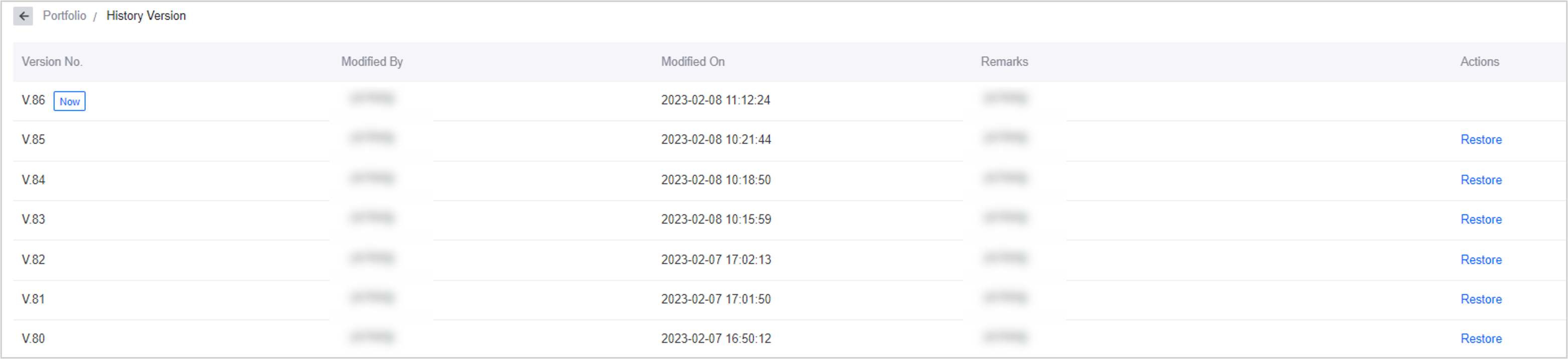
In the history version list, select Restore for the corresponding version.
Select OK in the pop-up window.
Note
The version history list retains at most the latest 100 history records.
Restoring a history version overwrites the current unpublished changes. The system will ask for confirmation before the operation.
Exporting or Importing a Page
Portfolio pages can be exported or imported in the form of JSON files, enabling the migration and reuse of the same page.
Exporting a Page
In the Portfolio configuration page, select Import/Export > Export, and the browser will automatically download the configuration file of the current Portfolio.
Importing a Page
In the Portfolio configuration page, select Import/Export > Import.
In the Import pop-up window, select the Upload button to upload the JSON file.
Select OK to complete the configuration import.
Only Portfolio configuration files can be imported, and the file size must not exceed 2 MB. If the file content does not contain asset, map, or canvas configurations, the system will prompt that the file type is not supported or the content is invalid.
Configuring URL Parameters
In addition to the above configurations, application developers can enable or disable page functions by configuring parameters in the menu URL, such as disabling page drill-down, specifying wind turbine animation colors, and enabling associated resources. For more information, see URL Parameters.