Using Common KPI Inquiry
This page describes how end users view metric reports in Common KPI Inquiry to aggregate and analyze asset data. The Common KPI Inquiry page is shown below.
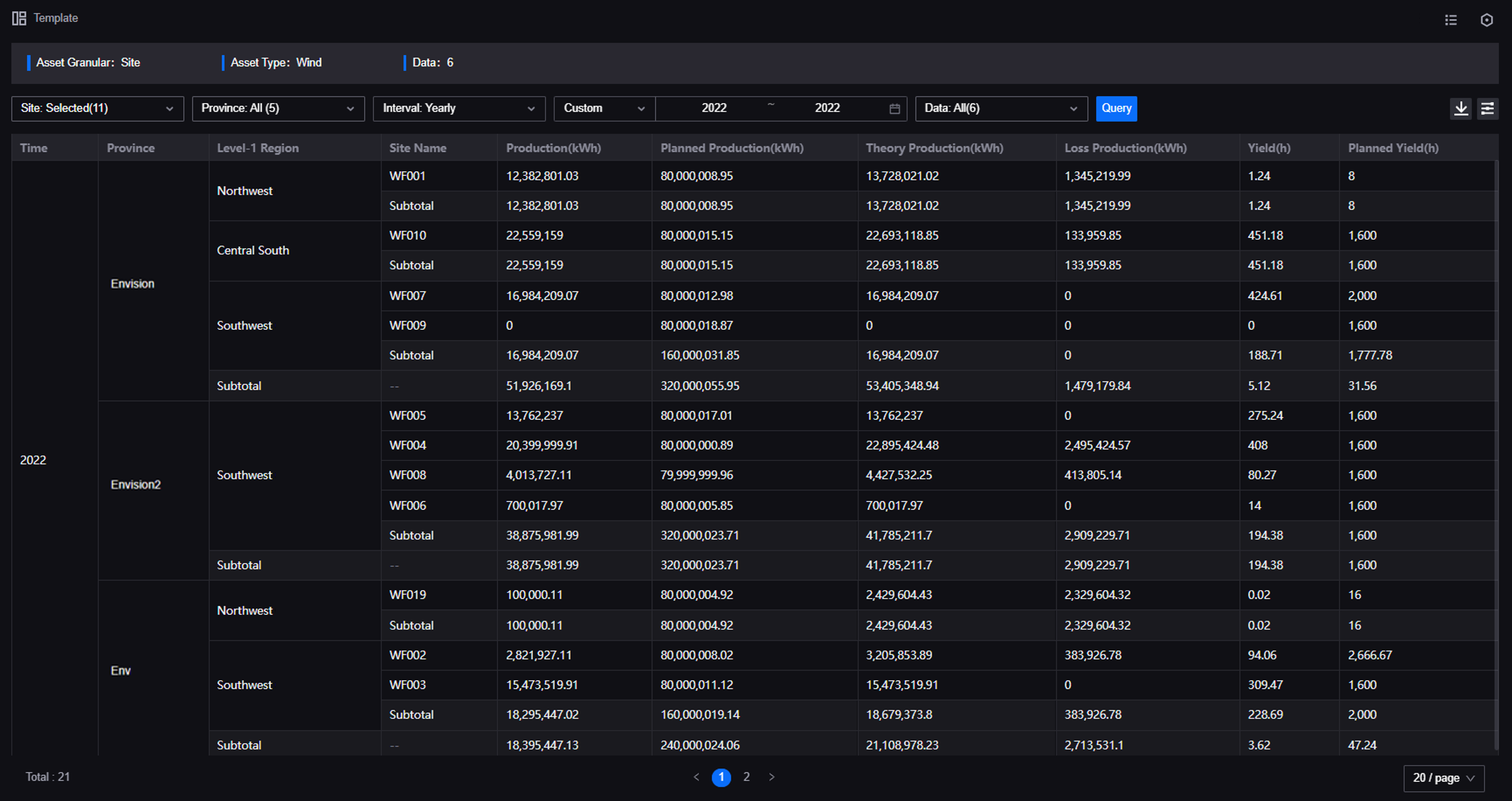
For more information about the page elements in Common KPI Inquiry, see Exploring Common KPI Inquiry.
Note
Unified Monitoring supports customized page layouts and functions, so the actual layout and functions might differ from this document. For assistance, contact the application creator.
Prerequisites
Before you start, make sure that the current account has been assigned the required asset permissions, operation permissions, and a menu group that contains the Common KPI Inquiry page. If not, contact your OU administrator.
Page Layout
From top to bottom, the Common KPI Inquiry page consists of a template bar, a report-scope summary bar, a filter row, and a report table. The entries of each area are as follows.
Area |
Entry |
Description |
Visibility condition |
|---|---|---|---|
Template bar |
Template |
Opens the template panel or the template drop-down list to apply saved report templates. It displays Template when no template is currently applied, and the template name when a template is applied. |
Templates are enabled by the application creator, or the current account has the template-configuration permission. |
Template bar |
Save |
Hover over this button to select Save Template or Save as Template. |
Same as above. Save Template is unavailable before the page has completed a query; Save as Template is unavailable when no template is applied. |
Template bar |
Function Configurations |
Opens the Common KPI Inquiry configuration page. |
The current account has the template-configuration permission. |
Report-scope summary bar |
Entire row / More |
Displays the number of Asset Granular, Asset Type, and Data items of the current query. Select the row or More to open the Report Configurations pop-up and modify the query conditions. |
Modify Query Conditions is enabled by the application creator, or the current account has the template-configuration permission. |
Filter row |
Various filters and Query |
Adjusts the assets, data, and time of the current query. For details, see Filtering Assets and Data. |
The page has completed a query. Each filter has its own enablement conditions. |
Filter row |
Filter |
Filters report rows by metric thresholds. For details, see Filtering Data by Conditions. |
Filter and sort by conditions is enabled by the application creator, subtotal by dimension is not currently enabled, and the report contains metrics that support filtering. |
Filter row |
Export |
Exports the current report data. For details, see Exporting Report Data. |
The current account has the export permission. |
Filter row |
Table Settings |
Adjusts the decimal places, frozen columns, and subtotals of the report. For details, see Configuring the Report Table. |
Always displayed. |

When you first enter the page and query conditions are not configured, the table area displays “Query conditions are not configured. Click here”; select here to open the Report Configurations pop-up. If the current account does not have asset tree permission or cannot modify query conditions, contact your OU administrator.
Filtering Assets and Data
For a generated report, you can adjust the query conditions through the filter row without opening the Report Configurations pop-up. The filter row is shown below.

The functions of the filters in the filter row are as follows.
Filter |
Description |
Visibility condition |
|---|---|---|
Asset filter |
Filters the rows in the report by asset. Which trees are displayed depends on the asset granularity: |
The asset filter is enabled by the application creator. |
Switch asset tree style |
Switches the display style of the device tree between |
The asset granularity is |
Dimension filter |
Filters the rows in the report by dimension value; each dimension with enumerated values in the report generates one filter. |
The dimension filter is enabled by the application creator, and the dimension has registered enumeration values. |
Enum filter |
Filters the rows in the report by the enumerated values of a data column, for example, viewing only devices in the Fault status by device status. All values are selected by default; the report has no data when none is selected. |
Filter by enum values is enabled by the application creator and enum filtering is enabled for the data item, the data column is currently displayed, and subtotal by dimension is not enabled. |
Time interval |
Specifies the time interval between adjacent data in the report. The available range is the intersection of the time intervals of all data items; |
The report contains metrics, and the time-interval filter is enabled by the application creator. |
Quick time range |
Quickly specifies the start and end time by preset ranges; the available options change with the time interval. For example, when the time interval is |
The report contains metrics, and the quick time range setting is enabled by the application creator. |
Custom time range |
Manually specifies the start and end time of the report data. The selection granularity of the calendar changes with the time interval; for example, selection is by quarter when the time interval is |
The application creator has enabled custom time ranges. |
Data column filter |
Selects the data columns to display in the report. Clearing the selection only hides the columns and does not change the query result. |
The data column filter is enabled by the application creator. |
Use the filters through the following steps:
Select Common KPI Inquiry from the left navigation pane.
Note
Unified Monitoring supports customized menu names, so the actual menu name might differ from this document. For assistance, contact your OU administrator.
Select the applicable filter and choose filter conditions from the drop-down list.
Select Query. Data that meets all filter conditions is displayed in the report.
When there are many filters that wrap to additional lines, use the expand and collapse buttons at the right of the filter row to collapse the extra filters. The entry for switching the organization structure is located in Report Configurations > Select Asset Scope, not in the filter row.
Filtering Data by Conditions
To view only assets whose metrics reach a specific threshold, for example, only sites whose power generation is below a specified value, filter the report data by conditions through the following steps:
Select Common KPI Inquiry from the left navigation pane.
Select Filter
 to open the filter pop-up.
Configure the filter conditions: select a metric, a comparison operator, and a value. The available comparison operators are determined by the filtering methods supported for the metric in Common Data Service.
To configure multiple conditions, select Add Filter, and select Or or And in the logic operator on the second row. The logic operator applies uniformly to all condition rows; changing the logic operator on any row is applied to all conditions.
Select OK. Only data that meets the filter conditions is displayed in the report.
Select Reset to clear the configured conditions and restore a single default condition.
After filter and sort by conditions is enabled, you can also select the header of a metric column to sort the report.
Note
Sorting and Group By Dimension are mutually exclusive: sorting a column automatically disables subtotal by dimension, and enabling subtotal by dimension clears existing sorting.
Viewing the Report
The report table provides the following capabilities to help you quickly locate target rows when the data volume is large:
Capability |
Description |
Conditions and Limitations |
|---|---|---|
Column order |
The column order of the report is: time columns, dimension columns, and data columns. Data columns are grouped, and the groups are displayed as second-level headers. |
The column order cannot be adjusted at runtime. The dimension order is adjusted in Report Configurations > Configure Dimensions and Statistics Rule, and the grouping and in-group order of data columns are adjusted in Select Data. |
Column width |
Column widths adapt to the content by default, and can also be adjusted manually by dragging the column boundary. Manually adjusted columns are no longer recalculated automatically. |
— |
Conditional color |
Data cells are colored by the conditions configured by the application creator, evaluated from top to bottom, and only the color of the first matching condition is used. Cells with no data are displayed as |
Conditions have been configured by the application creator for the data column. |
Merged cells |
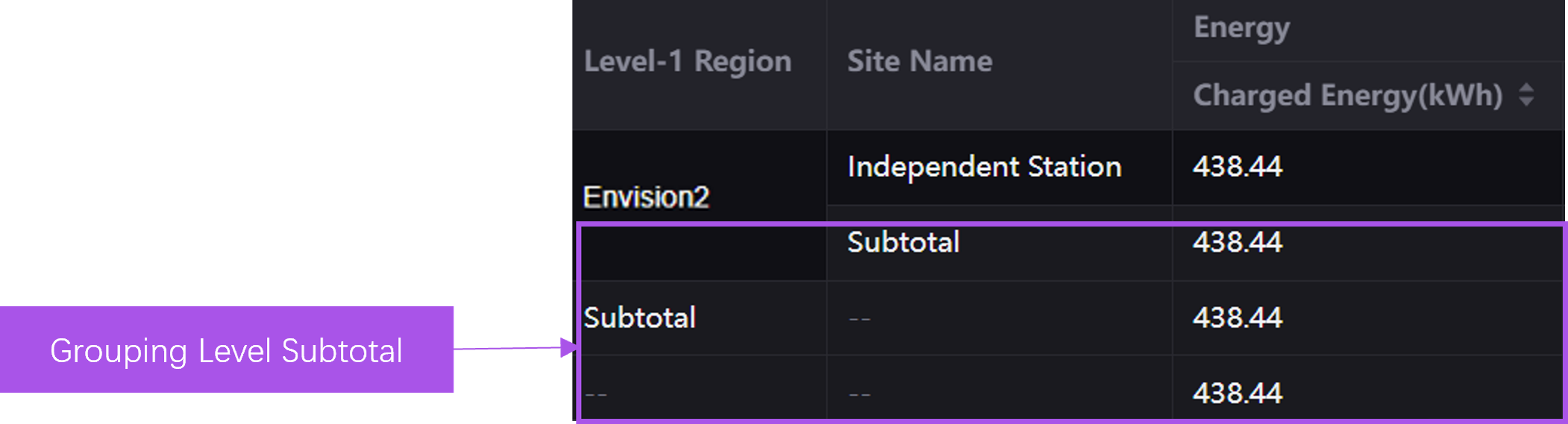
When Group By Dimension is enabled, cells with identical dimension values are merged vertically, and subtotal rows are marked with Subtotal. |
Merging takes effect only when subtotal by dimension is enabled. |
Total row |
When Time Subtotal is enabled, a total row for the whole time range appears in the report. The total row is located at the bottom of the last page or at the top of every page, depending on the configuration of the application creator. |
Time subtotal must be available. |
Action column |
The Action column at the far right of the report displays the action buttons configured by the application creator; selecting a button jumps to the specified address with the data of the current row. |
Appears only when the statistical method is |
Header tooltip |
When the cursor hovers over the header of a metric column, the metric name and the metric description under each asset type are displayed. |
— |
Pagination |
Page numbers can be switched at the bottom of the table; each page can display 20, 50, or 100 records, and the total count is displayed. |
— |
Configuring the Report Table
Adjust the numeric precision, frozen columns, and subtotal methods of the report through the following steps:
Select Common KPI Inquiry from the left navigation pane.
Select Table Settings
 at the right of the filter row to open the table settings pop-up and configure the following information.
Field
Description
Conditions and Limitations
Decimal Places
The number of displayed decimal places of values in the report. Select
Originalor 0–10. For example, selecting2displays values accurate to the hundredths place; selectingOriginalretains the original precision of the data and does not use thousands separators.Applies only to floating-point data; integer data never displays decimal places.
Freeze Columns
Freezes the first several columns at the left of the report to keep them always visible during horizontal scrolling. Select
None,First 1 Column,First 2 Columns, orFirst 3 Columns.—
Group By Dimension
Aggregates data by dimension level by level; rows with identical dimension values are merged and subtotal rows are generated.
Displayed only when the asset granularity is not
Device, there are no fewer than 2 non-time dimensions participating in the subtotal, and the dimension order meets the aggregation requirements. Sorting and enum filtering are unavailable when enabled.Time Subtotal
Adds a total row for the whole time range in the report; the position of the total row is configured by the application creator.
Displayed only when the current time interval is not
Accumulated, the selected metrics support accumulated statistics, and the application creator has not enabled Enable Non-Enumerated Dimension Display.Action Button
Configures the buttons in the action column of the report, up to 3. For details, see Configuring Action Buttons.
Visible only to users with the template-configuration permission, and not provided when the statistical method is
Summary.The effect of group-level subtotals is shown below.
Select OK. The system queries the data again after the settings take effect.
Applying a Report Template
A report template is used to fix a complete set of query conditions and display settings, avoiding repeated configuration each time. A template mainly includes asset granularity, asset types, asset scope, dimensions, statistical method, data columns and their order, time interval and time range, subtotal settings, decimal places, number of frozen columns, and filter conditions.
Templates are divided into two types: OU Template and My Template. The former is created by users with the template-configuration permission and is visible to all users in the OU; the latter is visible only to the creator.
Apply a report template through the following steps:
Select Common KPI Inquiry from the left navigation pane.
Select Template at the upper left of the page to open the template panel or the template drop-down list.
Select a template name in Recent Templates, or select a template in the template list below to apply it. When there are many templates, you can search by template name or group name in the search box, or expand the corresponding template group.
After applying a template, you can also perform the following operations:
Adjust the query conditions on top of the template, and then save the adjusted result through Save Template or Save as Template. For more information, see Managing Report Templates.
Select Clear Records to clear the records of recent templates. Up to 5 recent templates are retained.
If the asset types in the template no longer exist in the current organization structure, select assets again.
Exporting Report Data
To view, edit, or archive the current report offline, export the report data to an Excel file through the following steps:
Select Common KPI Inquiry from the left navigation pane.
Select the Export button
 at the right of the filter row. When the application creator has configured an address for exporting details, hovering over the button expands two options:
Export Current Query Results: Exports the data currently displayed in the report.
Export Detailed Data: Exports the detailed records corresponding to the report data, for verifying the source of the aggregated values.
The exported file is named in the format of {name}_YYYYMMDD. The template name is used when a template is currently applied, and the menu name is used when no template is applied; overly long names are truncated.
Note
The Export button is displayed only when the current account has the export permission, and is unavailable when there is no data in the report.
The number of data records exported at one time is limited, and the limit is lower when Group By Dimension is enabled. When the limit is exceeded, narrow the asset scope, reduce data columns, or shorten the time range before exporting. The specific threshold is determined by the deployment environment configuration; see Limitations.