Configuring Unified Asset Tree
Unified Asset Tree provides cross-page navigation and asset filtering. Legacy Landing Pages can associate first-level menus, organization levels, asset types, and second-level menus through this configuration. Asset Overview, Asset List, Charting Tool, and Common KPI Inquiry can also use the Application Portal asset tree, but their filtering behavior and configuration entry points differ.
Note
This page describes global Unified Asset Tree configuration for legacy Landing Pages. Configure page-level asset filters and the flat or hierarchical device-tree style in the corresponding feature page; they are not part of this global menu-association configuration.
Prerequisites
Before you begin, make sure that:
Your account has access to the Unified Asset Tree configuration menu, the required asset permissions, and write permissions for the target OU. Contact the OU administrator or system administrator if you cannot open or save the configuration.
The target application has an organization structure and the required assets are assigned to its nodes.
The first-level and second-level menus to associate with the tree have been created.
Opening Unified Asset Tree Configuration
Select Unified Asset Tree Configuration from the left navigation pane.
Note
Unified Monitoring supports customized menu names, so the actual name may differ. This configuration corresponds to the legacy Landing Page route
#/menu-conf; it is not the configuration wizard for an individual Asset Overview, Asset List, Charting Tool, or KPI Tool page.Review the first-level menus, their asset-tree types, and their configuration status in the configuration overview.
Selecting an Asset Tree Type for a First-Level Menu
Select the tree type from the Asset Tree drop-down list for the target first-level menu. Common types in the target environment are as follows; the actual options are subject to the page.
Asset tree type |
How to select it and applicable scenarios |
Runtime effect |
|---|---|---|
Combined hierarchy, single selection |
Users select one node from configured levels such as group, region, or site. Suits pages where the same entry needs to switch among multiple organization levels. |
At run time, the selected node changes the asset scope; whether a node is selectable still depends on asset permissions and associated-resource checks. |
Site, single selection |
One site is selected at a time. Suits single-site monitoring pages. |
Selecting a new site replaces the current selection. |
Site, multiple selection |
Multiple sites can be selected at the same time. Suits multi-site comparison or aggregation pages. |
The associated page receives an asset scope composed of multiple sites. |
No configuration required |
The first-level menu does not use the global Unified Asset Tree. |
The Unified Asset Tree entry provided by this configuration is not shown at run time; the page may still use its own asset filter. |
After selecting the tree type, select Configuration  beside the first-level menu to configure the associated menus.
Configuring Asset Types and Associated Menus
In Asset Type, select the site types available in the Unified Asset Tree. The selection order determines the runtime order of asset-type tabs.
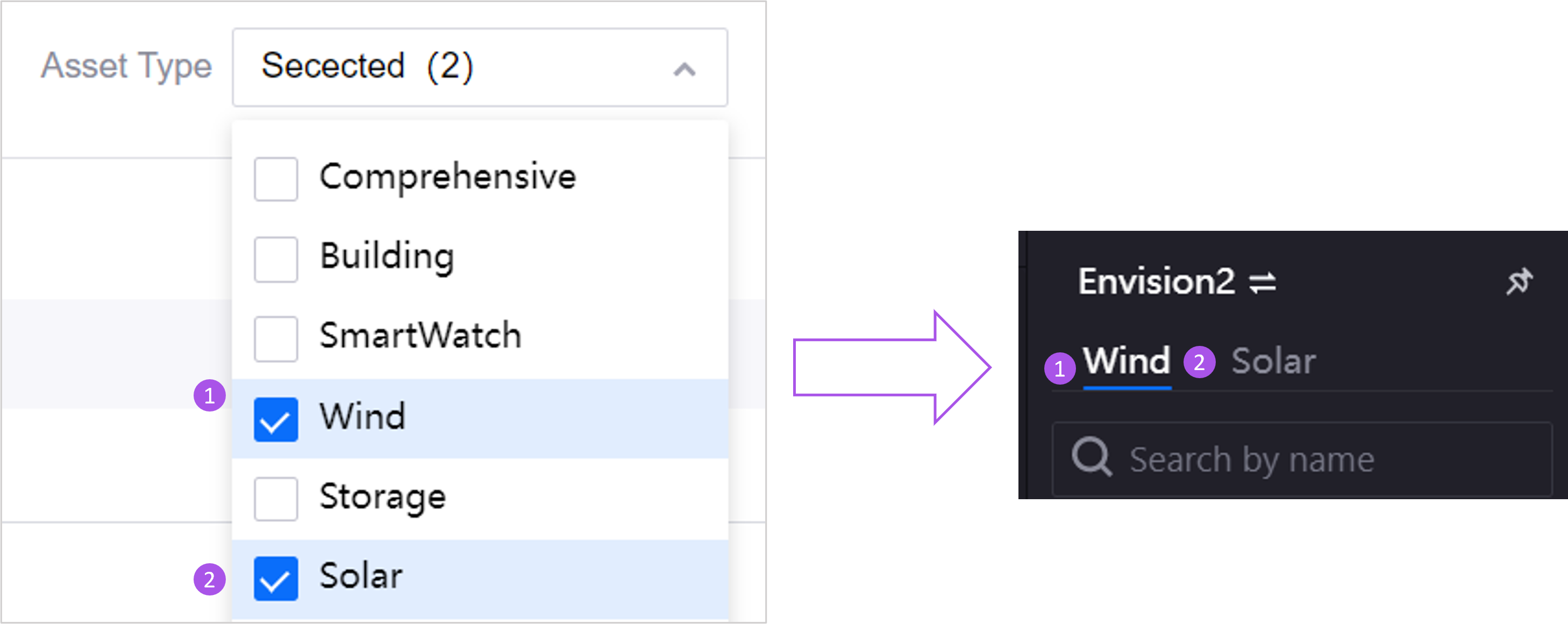
If Always Display the Current Asset Tree Name is available, enable it to always show the current tree name beside the asset-tree icon
 . When disabled, the name follows the page’s default interaction.
In the left panel, select a group, region, site level, or target asset type. Select Add Menu and associate the applicable second-level menus with that level or asset type.
To reuse the menu associations of another level or asset type, select the brush icon
 and specify the source.
Drag the sort icon
 on the left of a menu to change its display order. Select the remove icon
 to cancel an association.
Select OK to save the configuration.
Note
Some legacy versions show Synchronize Assets. This legacy menu-linkage field is not the same as page asset-selection memory, nor is it the same as Landing Page SDK asset-context synchronization. Its actual behavior is subject to the interface and version of the target environment.
Understanding Environment and Page Switches
The following switches are not edited on the Unified Asset Tree configuration page, but affect the runtime asset tree:
Capability |
Prerequisite |
Effect when disabled or not met |
|---|---|---|
Multiple asset-tree switching |
The deployment supports multiple trees, the menu does not set |
No switcher is shown; only the current tree is used. |
Associated resources |
The environment allows the asset tree to carry associated resources, and the target page or URL enables associated resources. |
Organization nodes can remain visible, but the page does not use their associated resources as the current business asset. For leaf nodes, the current implementation prioritizes the first associated resource. |
Filter unauthorized parent nodes |
The page URL uses |
By default, some parent nodes without direct asset permission may still be used to display the tree structure; when enabled, they are filtered out of the visible tree. |
Node permission check |
The target page enables associated-resource permission checking. |
Nodes without associated resources or permissions may be visible but not selectable; this capability is different from filtering unauthorized parent nodes. |
Asset-Tree Differences by Page
Page |
Primary role of the asset tree |
Configuration boundary |
|---|---|---|
Asset Overview |
Select a group, region, or site to change the asset scope of the map, canvas, and widgets; multiple sites can be selected in multi-site dimensions. |
The in-page asset filter is controlled by the Asset Overview configuration. |
Asset List |
Filters list and card data by the site, region, or device dimension. |
The flat or hierarchical device-tree style is controlled by the Asset List page configuration. |
Charting Tool |
Selects a site group, site, or device for trend analysis. |
The device-tree style and cross-site scope are controlled by the Charting Tool configuration. |
Common KPI Inquiry |
Selects a site, device group, or device as the report query scope. |
In device big-data mode, only a site may be selectable and the device tree is not expanded. |
Landing Page |
Acts as a container to provide unified asset and asset-tree context to embedded pages. |
The asset-filter header is configured in the Landing Page five-step wizard; the global sidebar and context menu use the adjunct entries described on this page. |